Cape Coral Gulf-Access Canals: What Every Buyer Needs to Know Before They Offer
Cape Coral has more miles of navigable waterway than any city in the world — more than 400 miles of canals cut into the western tip of Lee County’s mainland. That number gets repeated in every listing description, every tourism brochure, and every dinner conversation when someone mentions they’re thinking about buying there. What rarely gets explained is that those 400-plus miles are not equal, not interchangeable, and not all connected to the Gulf of Mexico in any useful way for a boater.
About half of Cape Coral’s canals are freshwater — retention and drainage systems built to manage rainfall and stormwater. They’re pleasant to look at from your lanai. You can kayak them. You cannot take a 35-foot center console out of one and be on open water in time for a sunrise fishing run. The other half are saltwater, and within that saltwater half, there’s a further critical split: direct Gulf access versus lock-restricted access. That distinction alone can mean a $150,000 to $500,000 price difference on otherwise comparable homes, and it is the single most important question a Cape Coral buyer needs to answer before they write an offer.
This guide walks through exactly how Cape Coral’s canal system works, what to look for in each zone, what the 2026 market has done to the price gap between access tiers, and what I tell buyers on the first call — before we ever look at a photograph.
The canal system, honestly explained
Cape Coral was developed in the late 1950s and 1960s by Gulf American Land Corporation, which dredged the canals to make interior lots saleable as “waterfront” parcels. The original plan was straightforward: cut canals from the Caloosahatchee River and Matlacha Pass into the interior, sell the dredge spoil as fill for the lots alongside, and market the result as a boater’s paradise.
The engineering worked. The marketing, for some buyers, requires a footnote.
Gulf-access saltwater canals (direct)
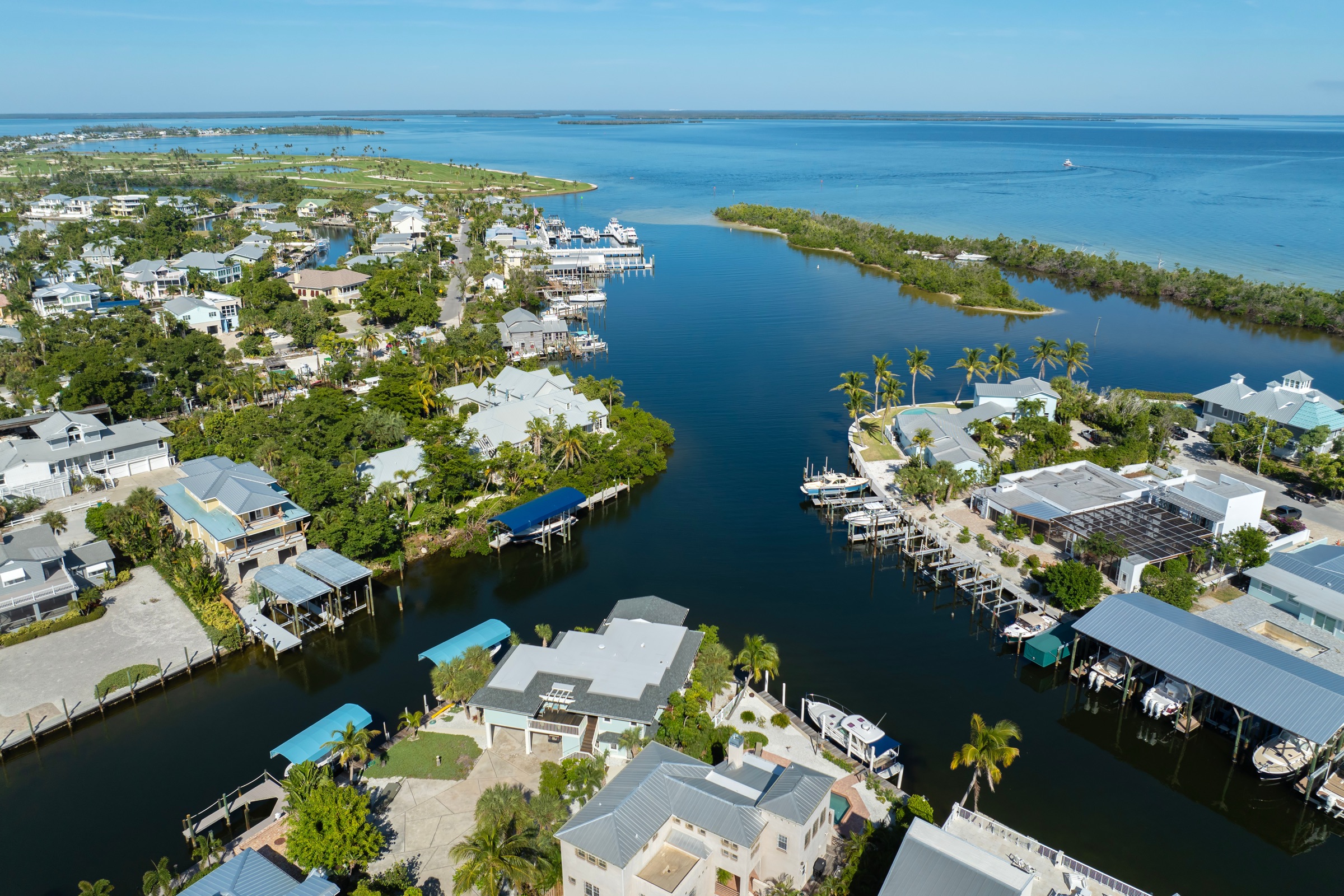
The northwest quadrant of Cape Coral — roughly the area bounded by SW 47th Terrace on the south and Pine Island Road on the east — contains the city’s direct-access saltwater canal network. Homes here connect, by canal, to Matlacha Pass and from there to Pine Island Sound and the Gulf. Travel time from a typical northwest-quadrant dock to open water runs 25 to 45 minutes depending on location and vessel draft.
Direct-access canals range in depth from about 6 to 9 feet at mean low water in the primary channels. Side canals, the streets-off-streets, run shallower — typically 4 to 6 feet. That’s generally enough for a center console or a smaller sportfish with moderate draft, not enough for a deep-V hull drawing more than five feet.
What direct access means for price: on a per-square-foot basis, verified Cape Coral closings in the first half of 2026 placed direct-access waterfront homes at a consistent 25 to 40 percent premium over comparable non-waterfront properties in the same sections. A three-bedroom, pool, dock home in the NW quadrant that would list at $550,000 without water access routinely trades between $720,000 and $850,000 with it.
Lock-restricted saltwater canals (indirect)
The Spreader Waterway system, which runs through the central and southern sections of Cape Coral, was built with control locks to manage water levels and prevent saltwater intrusion into the city’s freshwater utility canals. Homes on the saltwater side of those locks have saltwater access — but getting to open water means transiting through the lock, which introduces wait times, operating hours, and minimum clearance questions for sailboats or vessels with tall superstructures.
Locks operate with regulated hours. At peak seasons, weekend wait times of 20 to 40 minutes at the lock are not unusual. The Ceitus and Chiquita locks are the primary points buyers should research for properties in the southern saltwater sections.
For many buyers — particularly those with smaller vessels, or those who fish the back country and backcountry bays rather than running offshore — lock access is perfectly workable. For buyers who want to leave the dock at 4:30 a.m. for a run to the snapper grounds without queuing, it’s a friction cost worth pricing honestly.
Freshwater canals
Freshwater canals — concentrated in the southeast and northeast sections of Cape Coral — are drainage and retention features, not navigation corridors. Homes on freshwater canals are aesthetically appealing and often priced as waterfront, but their canal access has no connection to tidal water. A boat on a freshwater Cape Coral canal stays on that canal.
There is nothing wrong with a freshwater canal home if boating access isn’t the priority. They’re quieter, they have no wake issues from passing traffic, and the price-per-square-foot is materially lower than saltwater equivalents. I’ve closed three freshwater canal purchases in Cape Coral in the last 18 months for buyers who wanted the waterfront aesthetic and the pool-to-canal view without any interest in docking a boat. Every one of them was happy with the decision because we established the distinction before they offered, not after.
The four questions to answer before you offer on any Cape Coral waterfront home
1. Is the canal saltwater or freshwater — and does the listing say so clearly?
It frequently doesn’t. “Waterfront” in a Cape Coral listing means one of four things: direct Gulf-access saltwater, lock-restricted saltwater, freshwater with no tidal connection, or — occasionally — a lot that backs to a drainage ditch that someone photographed generously. The listing description may say “sailboat access” (a common shorthand for deep, bridge-free direct access) or “Gulf access” without specifying whether there are lock delays.
The reliable way to check: use the Lee County Property Appraiser’s parcel data to identify the canal ID, then cross-reference with the Cape Coral Utilities water-distribution maps. Your agent should do this for you before a showing, not after an offer.
2. What is the bridge clearance?
Even on direct-access saltwater canals, bridges cross the water between your dock and open water. In northwest Cape Coral, most residential bridges carry between 8 and 10 feet of clearance at mean high water. That clears a center console with a T-top or a single-engine sportfish. It does not clear a twin-engine sportfish with a tower, a larger cruiser, or any sailboat with an unstepped mast.
Get the full route from the dock to open water. Measure every bridge. A buyer who purchased a northwest Cape Coral home in 2024 with a 43-foot Contender in mind discovered during the inspection period — not before the offer — that a bridge on the route carried 9.5 feet of clearance. The Contender draws 10 with its T-top. He negotiated the bridge measurement as a contingency, found one more bridge at 9.3 feet, and eventually walked from the deal. His broker should have run the route before the offer. I do it for every boat-owning buyer, every time, with a measuring tape in the boat.
3. What is the canal depth at mean low water — at the dock?
Charted depths are averages. The depth at a specific dock, at mean low water, may be two or three feet shallower than the charted channel depth if there’s been silting, if the previous owner dredged poorly, or if the lot is near a curve in the canal where sedimentation collects.
I order a depth sounding at the dock as part of standard pre-offer diligence on any Cape Coral waterfront. A local marine service does this for $300 to $500 and delivers results in three to five days. It has saved buyers from expensive mistakes more than once.
4. What has the flood insurance history looked like — and what will it cost at your vessel?
Cape Coral sits in a federal flood zone. The vast majority of waterfront parcels are AE-zone, with base flood elevations ranging from 8 to 12 feet depending on location. After FEMA’s Risk Rating 2.0 methodology took full effect in 2026, NFIP premiums on older Cape Coral homes — particularly pre-FIRM construction from the 1970s and early 1980s — moved significantly.
Homes with current elevation certificates showing elevation of base flood elevation plus two or more have consistently fared better on private-market insurance (Neptune, TypTap, Citizens alternatives) than on NFIP. Before you offer on a Cape Coral waterfront home, request the current NFIP declarations page, not the seller’s memory of what they paid in 2022. On a $750,000 acquisition, a $4,000-per-year difference in insurance cost affects your effective yield materially if you’re treating this as an investment property.
What the 2026 market has done to Cape Coral waterfront
The price gap between direct Gulf-access homes and freshwater-only homes widened in the first half of 2026. Median days on market for direct-access listings in the NW quadrant dropped to approximately 28 days in Q1 before rising slightly to 41 days in Q2 as inventory ticked up. Freshwater canal homes in the SE and NE sections have been sitting longer — median 55 to 70 days in Q2 — reflecting a market that has absorbed the messaging that not all Cape Coral waterfront is equivalent.
Buyers from out of state, particularly from the Midwest and Northeast, still occasionally purchase freshwater canal homes believing they’re buying boat-accessible waterfront. The correction happens either at due diligence (if they have a thorough buyer’s agent) or after closing (when they haul a boat down and discover there’s nowhere for it to go). The second scenario is now more common than it was three years ago because so many of these transactions happened during the 2021–2022 surge when buyers waived inspections and due-diligence periods.
A well-represented buyer today insists on water-access verification as a non-negotiable contingency, whether the inspection period is seven days or fourteen. It’s a two-day task. There’s no excuse to skip it.
Dock and lift considerations specific to Cape Coral
The standard in Cape Coral’s residential canal market is a fixed dock with a single or dual boat lift, typically rated for 10,000 to 16,000 pounds. Most parcels allow docks under a Lee County permit process. Seawall condition is the variable buyers undervalue most: a seawall replacement on a typical Cape Coral canal lot runs $35,000 to $65,000 depending on linear footage and wall condition, and older homes from the 1970s and 1980s frequently have seawalls that are serviceable but within five to ten years of needing replacement.
Have a marine contractor walk the seawall during the inspection period. A visual inspection by a home inspector, who typically does not have marine credentials, is not sufficient. The seawall is load-bearing infrastructure for the dock, the lift, and — if the wall fails — potentially for the landscaping and lanai footings beside it.
On direct Gulf-access lots, a well-maintained dock with a 13,000-pound lift adds roughly $40,000 to $70,000 to the sale price compared to an equivalent lot with no dock. That premium is real and recoverable at resale if you maintain it.
Cape Coral neighborhoods, by access tier
Northwest Cape Coral (Sections 73–91 area) — the strongest direct Gulf-access corridor. Primarily built from the 1980s through early 2000s, with significant new construction on infill lots. Most sought-after for serious boaters. Median 2026 H1 closing on direct-access waterfront: approximately $820,000 for a three-to-four bedroom with dock and pool.
Southwest Cape Coral (Spreader Waterway system) — lock-restricted saltwater access to San Carlos Bay and the Caloosahatchee. More affordable entry point for boaters who accept lock transit. Growing inventory of newer builds. Median 2026 H1 closing on lock-access waterfront: approximately $620,000.
Southeast Cape Coral — mixed freshwater and limited saltwater. More suburban in character. Strong value for non-boating buyers who want the waterfront aesthetic at a lower price point. Median 2026 H1 closing on waterfront: approximately $430,000.
Northeast Cape Coral — predominantly freshwater canals, close to Cape Coral Parkway and Burnt Store Road. Family-oriented neighborhoods, larger lot sizes. Median 2026 H1 waterfront closing: approximately $380,000.
What I tell buyers on the first call
I ask three questions before we discuss price range or bedroom count:
What boat are you bringing, or planning to buy? What’s the LOA, draft, and top-of-T-top clearance? And what does your ideal morning on the water look like — backcountry, nearshore, or offshore?
Those answers tell me exactly which Cape Coral sections are physically compatible with your program and which are not. Everything else follows from there. I’ve had buyers come to me with a $900,000 budget, strong direct-access options, and a 36-foot center console that would fit their dock perfectly. I’ve also had buyers with the same budget who wanted offshore capability — and after running the bridge route, we ended up looking at Fort Myers Beach and Pine Island instead. Both were the right outcome because we asked the question before the tour, not during it.
FAQ
Q: Can you take a boat from Cape Coral to the Gulf of Mexico? Yes, but not from every canal. Direct-access homes in northwest Cape Coral connect to Matlacha Pass and Pine Island Sound, with open Gulf water reachable in 25 to 45 minutes. Homes on the Spreader Waterway system require transiting a control lock, adding 20 to 45 minutes depending on wait times. Freshwater canal homes have no tidal connection and cannot access the Gulf by boat.
Q: What is the price premium for direct Gulf access in Cape Coral? Based on 2026 first-half closings, direct Gulf-access waterfront homes in northwest Cape Coral command a 25 to 40 percent premium over comparable non-waterfront properties in the same sections, and roughly 20 to 30 percent over lock-restricted saltwater waterfront homes.
Q: How deep are Cape Coral’s Gulf-access canals? Primary access channels run 6 to 9 feet at mean low water. Residential side canals typically run 4 to 6 feet. Depth at a specific dock may vary due to silting. Always order a pre-offer depth sounding — it costs $300 to $500 and takes two to five days.
Q: Are Cape Coral canals safe to swim in? The saltwater canals are tidal and active with boat traffic, and are not generally used for swimming. Freshwater canals are not recommended for swimming due to water quality and the presence of alligators, which are common throughout Southwest Florida’s freshwater systems.
Ready to find the right Cape Coral canal home?
Buying on the water in Cape Coral requires more due diligence than the listing photos suggest — but done right, it’s one of the strongest value propositions in Southwest Florida waterfront real estate. Direct Gulf access, a maintained dock, and a pool on a northwest Cape Coral lot in the $750,000 to $900,000 range represents a boat lifestyle that would cost three times as much in Boca Grande and twice as much in Naples.
I represent a small number of Cape Coral waterfront buyers each quarter. If you’re looking to be on the water in Lee County and want a broker who will run the bridge route before the showing, book a call.
Schedule a private buyer consultation →
Sabatino Campilii is the licensed Florida REALTOR® (SL3363040) behind OceanFL, serving buyers across Charlotte Harbor, Lee County, and the greater Southwest Florida waterfront market.

Realtor®, License SL3363040
Engineer, 25-year builder, and licensed Realtor® representing buyers and sellers across the Southwest Florida Gulf-coast pockets. Reviewed and published July 25, 2026.
Have Sabatino represent you — before you call any listing agent.
Start your discovery call →