Cape Coral Buyer’s Guide to Freshwater vs Saltwater Canals
Almost every Cape Coral listing says “waterfront.” Very few of them explain which water. That single missing word is the reason buyers close on a home, back the boat trailer down the ramp for the first time, and discover that the canal behind the house does not go anywhere they wanted to go. Buyers relocating from out of state and cross-shopping Naples against Cape Coral will find our Naples neighborhood guide for relocating buyers useful for comparing the two markets. Buyers weighing a canal-front condo against a single-family lot should also read our condo vs. single-family comparison for the maintenance and ownership tradeoffs. Canal type varies by quadrant as much as by street, so read our how Cape Coral’s quadrants break down alongside this guide before narrowing your search.
Cape Coral occupies the peninsula between the Caloosahatchee River and Matlacha Pass in Lee County. It was platted and dredged starting in the late 1950s by Gulf American Land Corporation, and the canal network they cut is the largest of its kind anywhere. Those canals were not built as one system. They were built as two, for two entirely different purposes, and the difference still governs how a Cape Coral home lives sixty-plus years later.
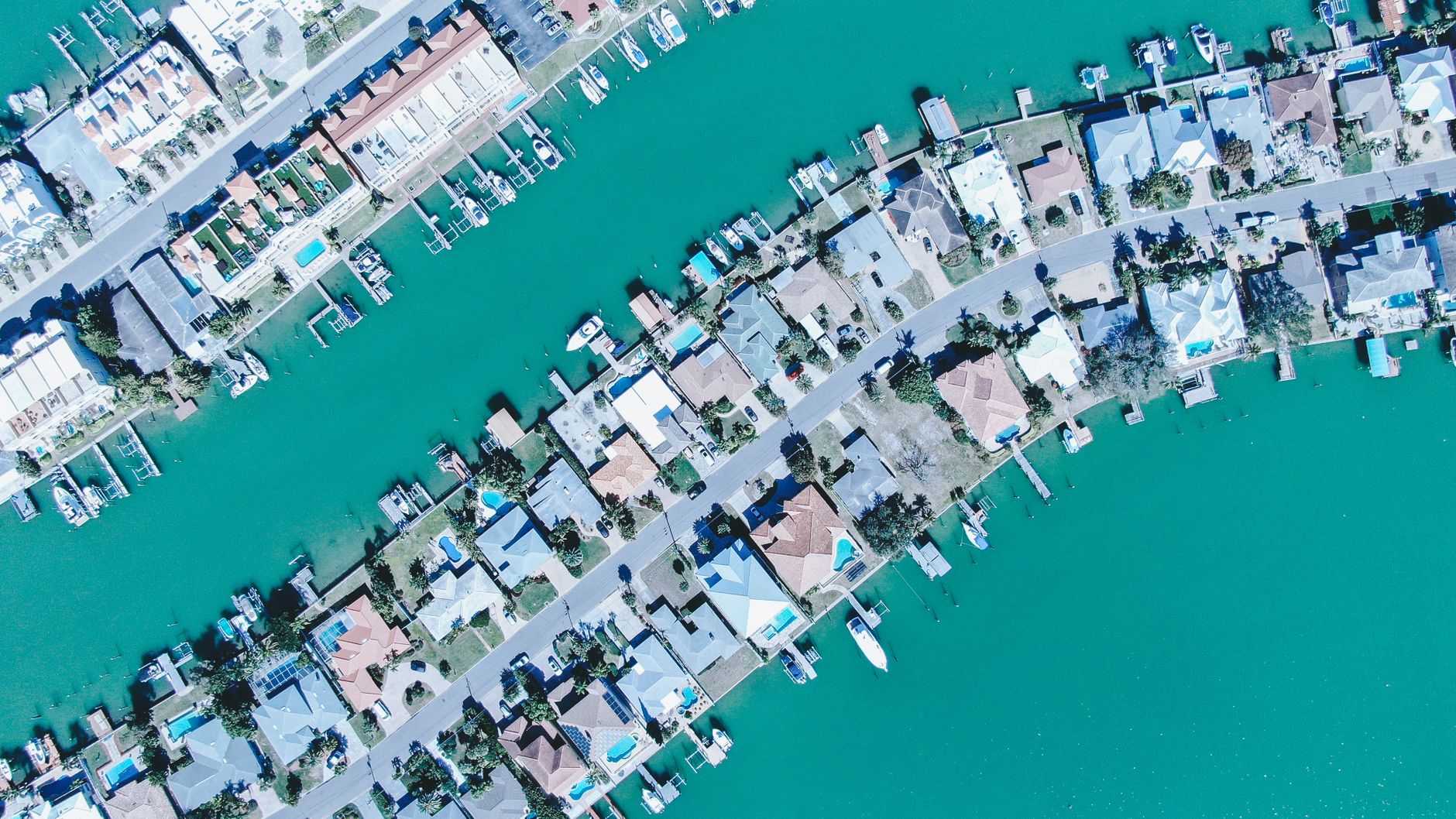
Cape Coral’s Two Canal Systems
The saltwater canals connect — directly or through a lock — to tidal water: the Caloosahatchee River on the south and east, Matlacha Pass and Charlotte Harbor waters to the north and west. They are brackish, they rise and fall with the tide, and they are the reason people buy in Cape Coral to keep a boat behind the house — our buyer’s guide to Cape Coral’s gulf-access canals goes deeper on how to evaluate a specific saltwater canal lot.
The freshwater canals are a separate, largely landlocked network in the central and northern interior of the city. They function as a stormwater and drainage system, holding and moving rainfall so the interior does not flood during summer downpours. They are not tidal, they have no outlet a cruising boat can use, and in most of the network the water level is managed by weirs and control structures rather than by the Gulf.
Both are “waterfront.” Only one is boating water in the offshore sense. When you are reading a listing, the phrase you want is not “canal front” — it is one of: direct Gulf access, sailboat access (meaning no fixed bridge between the property and open water), bridge-restricted access, lock access, or freshwater. If a listing does not say which, that is the first question to ask, and the answer should be verified against the actual water body rather than the marketing copy.
What Freshwater Canals Offer Owners
Freshwater canal living is genuinely appealing to a large share of buyers, and it gets dismissed too quickly by people who assume every Florida buyer wants an offshore boat.
You get a wide, quiet water view with far less through-traffic than a busy saltwater run. You can keep a kayak, a paddleboard, a small electric-motor skiff, or a pontoon for cruising the interior system. Freshwater fishing — largemouth bass, bluegill, tilapia — is right off the dock. There is no salt spray corroding rails, hinges, outboard hardware, and lift cables, which is a real and ongoing cost difference on the saltwater side.
Freshwater lots also generally cost less than comparable homes on Gulf-access water. That gap buys square footage, a newer roof, a better pool, or a shorter drive to the parts of the Cape you actually use. For a buyer whose water plan is “I want to look at it, kayak it, and fish it,” the freshwater system delivers most of the pleasure at a materially lower entry point.
The honest tradeoff: freshwater water levels fluctuate with rainfall and the city’s stormwater management, so the view in a dry spring can sit noticeably lower than the view in September. Vegetation management along the banks is an ongoing task, and aquatic weed treatment is a normal part of the system’s upkeep.
Saltwater Canals and Gulf Access Routes
On the saltwater side, the geography of your specific canal determines your boating life more than the house does.
Southern and southeastern Cape Coral canals feed the Caloosahatchee River, which is the working artery of the region — it connects downstream past Fort Myers toward San Carlos Bay, Sanibel, and the Gulf, and upstream it forms part of the Okeechobee Waterway crossing the state. Homes in the southeast Cape are typically the shortest runs to open water.
Northwest Cape Coral canals feed toward Matlacha Pass and the shallower, more protected backwaters between the mainland and Pine Island. The character of that boating is different: skinny water, grass flats, mangrove shoreline, redfish and snook rather than a straight run offshore. Boats that draw a lot of water and captains who want a quick, deep, unambiguous route to the Gulf are usually happier on the south side.
If a Gulf-access run matters to you, read our companion piece on Cape Coral Gulf-access canals, which goes deeper into the access tiers and the bridge question.
Lock Systems and Transit Considerations
Part of Cape Coral’s saltwater network is separated from open tidal water by a lock. A lock is a chamber with gates at each end; you enter, the gates close, the water level is equalized to the other side, and the far gates open. It exists because the canal system on one side sits at a different managed level than the tidal water on the other, and because the city needs to control salinity intrusion into the interior.
Lock access is real Gulf access — you can get a boat out. It is simply slower and scheduled around the lock’s operating reality. On a busy weekend morning, the queue matters. For an owner who runs offshore twice a month, that is a nuisance. For an owner who takes the boat out most Saturdays at first light, it can reshape the whole ownership experience.
Before you write an offer on a lock-served canal, do the transit yourself. Put the boat, or a friend’s boat, in the water and run the route you would run. Time it. Then decide.
Maintenance Differences Owners Report
Saltwater ownership carries a corrosion budget. Lift cables, motors, and switches, dock hardware, seawall tiebacks, outboard anodes, trailer components, screen enclosure fasteners — everything metal on the water side wears faster in a salt environment, and the pace of replacement is not a surprise to anyone who has owned there a few years.
Seawalls sit at the center of that budget on both systems. A Cape Coral seawall is a structural asset with a finite life, and its condition is one of the largest dollar variables in any canal-home purchase. Cracking, tie-back failure, and voids behind the cap are the things to look for, and they are not reliably visible from a listing photo. This is precisely the kind of item that belongs in a specialist inspection rather than a general home inspection — see what to add to a waterfront inspection.
Freshwater ownership trades corrosion for vegetation and water-level management. Less hardware replacement, more shoreline maintenance.
How Location Shapes Everyday Boating
Two homes can both say “Gulf access” and produce completely different Saturdays. What actually determines your experience:
- Distance to open water, measured in running time at a sane speed, not in map miles.
- Fixed bridges on the route. A fixed bridge sets a hard vertical limit. Any boat with a mast, a tall tower, or a large hardtop is constrained by the lowest fixed structure between the dock and open water. This is why “sailboat access” is a distinct and premium category in Cape Coral.
- Canal width and turning room, which decides what length of vessel you can realistically dock, back out of, and maneuver.
- Water depth at low tide at your dock, not at the canal’s midpoint. The number that matters is the one under your keel at the bottom of the tide.
- Direction the canal faces, which sets your afternoon sun, your evening view, and how much wind chop reaches your lift.
Measure all five for the specific address. None of them can be inferred from the neighborhood.
Deciding Which System Fits Your Plans
Work backward from the boat, not from the house.
If the vessel is a kayak, a paddleboard, or a small pontoon and the point is the view and the quiet, the freshwater system is very likely the better value and the lower-maintenance ownership.
If the vessel is a center console you intend to run to the Gulf regularly, you want direct or minimally bridged saltwater access on the south side of the Cape, and you should be prepared for the price step that comes with it.
If the vessel is a sailboat or anything tall, “no fixed bridges” is not a preference — it is a filter that eliminates most of the inventory before you tour anything.
And if you do not own a boat yet and are not certain you will, buying freshwater and renting or storing at a marina is a rational, common, and frequently cheaper path than paying the Gulf-access premium for a dock that sits empty.
Cape Coral is not the only version of this decision on the Gulf coast. If you are still comparing markets, Punta Gorda Isles and the broader Charlotte Harbor shoreline answer the same question with different geography.
If you want help mapping a specific Cape Coral address to its actual water — which system it is on, what the route to open water looks like, and what to verify before you offer — reach out to Sabatino Campilii, Realtor®, License SL3363040. Bring the boat you own or intend to own, and we will work the problem from there.
Sabatino can answer it in five minutes — no pressure, no listing-agent spin.

Realtor®, License SL3363040
25-year builder, developer, and licensed Realtor® representing buyers and sellers across the Southwest Florida Gulf-coast pockets. Reviewed and published June 8, 2026.
Have Sabatino represent you — before you call any listing agent.