Salt Air Maintenance for Coastal Homes
Buyers touring Gulf-front and canal-front homes tend to focus on the things that photograph well. The owners who have been here twenty years focus on hinges, coils, and fasteners — because on a barrier island or a canal a few hundred feet from open water, salt is the single most persistent force acting on the property, every hour, whether anyone is home or not. Pool equipment near salt air ages differently than inland, and our inspection guide for pool homes on the water covers what to have checked before closing.
I’m Sabatino Campilii. I work Gasparilla Island and the Charlotte Harbor mainland, and this is the practical maintenance conversation I have with buyers who are coming from inland markets and have never owned in a marine environment.
What Salt Air Actually Does to a Home
Salt reaches your house two ways. Direct spray hits anything within throwing distance of surf or a wind-driven chop. Far more homes are affected by aerosol: microscopic salt particles carried inland on the sea breeze, settling on every surface, then absorbing humidity out of the air.
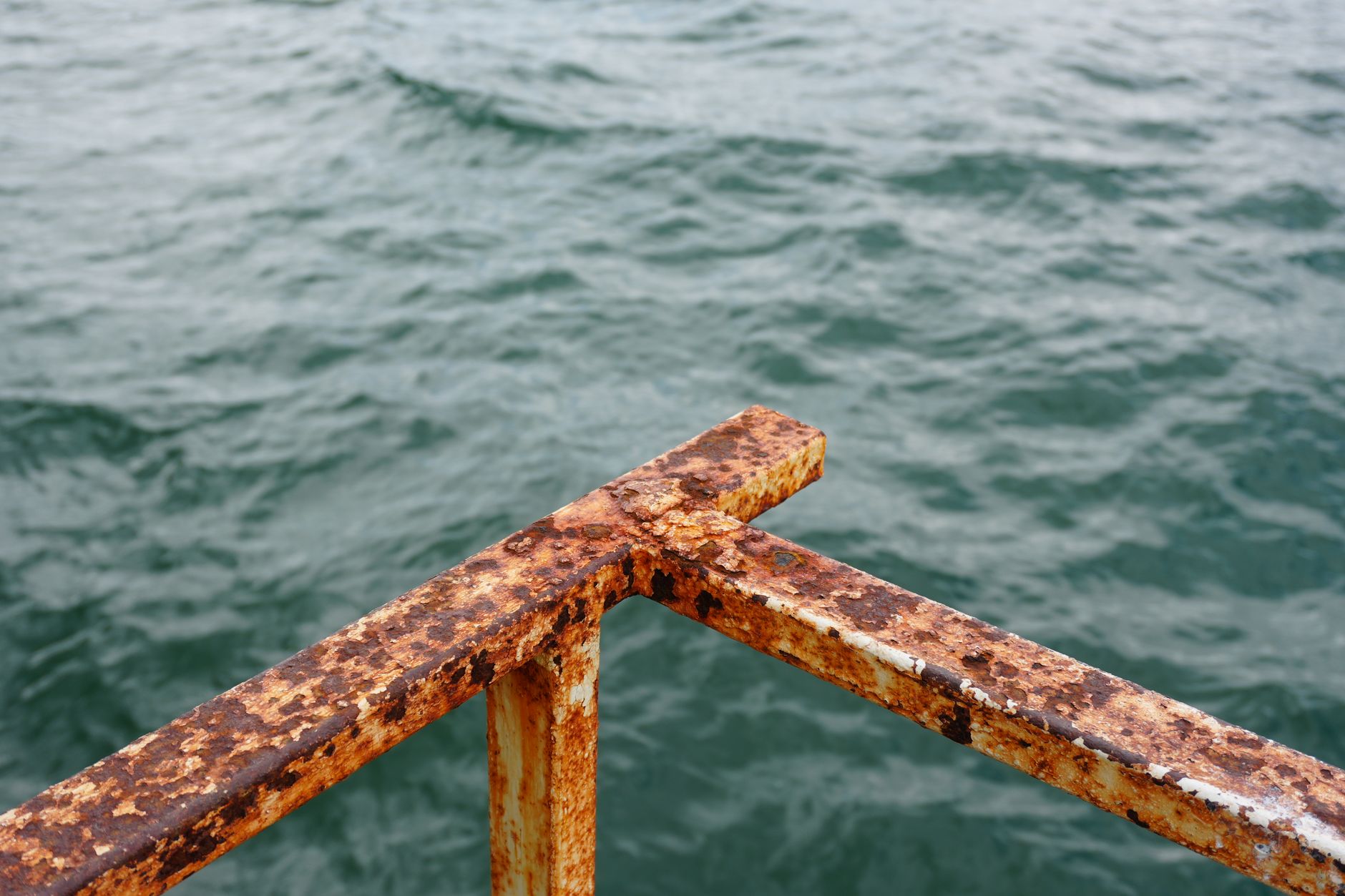
That last part is the mechanism people underestimate. Salt is hygroscopic — it pulls moisture from the air and holds it against a surface. A metal component coated in salt film is effectively kept damp with a mildly conductive electrolyte solution, which accelerates corrosion far beyond what the same component would experience inland. Combine that with year-round warmth and high humidity, and you get chemistry that runs continuously instead of seasonally.
The consequences show up in a predictable order. Unprotected steel goes first. Aluminum develops pitting and white oxidation. Dissimilar metals in contact corrode galvanically at the junction. Coatings chalk and fail early. Electronics and electrical contacts degrade. Wood finishes break down under combined salt, humidity, and ultraviolet exposure.
Distance from the water matters enormously, and so does orientation. A house directly facing the Gulf with prevailing onshore wind takes a dramatically heavier load than one three streets inland behind a canopy of trees. Elevation matters too. So does whether the home sits empty for months — an unoccupied house accumulates deposits with nobody rinsing them off.
Exterior Hardware and Fasteners
Hardware is where failure appears first and where good specification pays for itself many times over.
Fasteners. In this environment, stainless is the baseline, and not all stainless is equal. The higher-alloy marine grades resist chloride pitting considerably better than the common general-purpose grade. When replacing exterior fasteners — on railings, shutters, docks, light fixtures, or anything structural — specify a marine-appropriate grade and be consistent. Mixing metals invites galvanic corrosion at every connection.
Door and window hardware. Hinges, locksets, sliding-door rollers and tracks, and garage door springs and rollers all take a beating. Sliding glass door tracks in particular collect salt and grit and then grind themselves apart. Clean tracks regularly and lubricate with a product intended for marine use rather than a general household spray.
Light fixtures and exterior electrical. Specify marine-rated or coastal-rated fixtures. Inspect outdoor outlets, covers, and disconnects for corrosion at the terminals. Corroded connections are both a reliability and a safety issue and belong on a licensed electrician’s list rather than yours.
Hurricane protection hardware. Shutter tracks, bolts, wing nuts, and anchors are exactly the components you need to work perfectly on short notice. Exercise them before each storm season, not during a watch.
Any of this that looks marginal at inspection is worth pricing before closing rather than discovering afterward. It also pairs with the structural questions I raise in the Punta Gorda Isles canal maintenance guide for anyone buying behind a seawall.
HVAC Coils and Outdoor Equipment
The outdoor condensing unit is the most expensive salt casualty in a typical coastal home, and the most preventable.
The condenser coil is a large array of thin metal fins whose entire job is to sit outdoors and move air across itself. That makes it an efficient salt collector. As salt accumulates and corrodes the fins and tubing, heat transfer drops, the system works harder, efficiency falls, and eventually a coil leaks refrigerant. Coastal homes routinely see shorter condenser life than inland homes for exactly this reason.
Three things extend it substantially:
Rinse the coil regularly. A gentle freshwater rinse — low pressure, never a pressure washer, with the unit powered off at the disconnect — removes accumulated salt before it does its work. Monthly is reasonable near open water; quarterly is a defensible minimum further inland. Have a technician do it if you are not comfortable at the disconnect.
Specify coastal-rated equipment. Manufacturers offer coil coatings and corrosion-resistant cabinets specifically for marine environments. When replacement time comes, the premium is small relative to a shortened service life.
Site it thoughtfully. Some shelter from direct salt spray and prevailing wind helps, provided airflow clearances required by the manufacturer are maintained.
The same logic applies to pool equipment, generators, irrigation controllers, outdoor kitchens, boat lift motors, and anything else with metal and electronics living outdoors. Rinse it, cover what can be covered without trapping moisture, and inspect the electrical terminations annually.
Screens, Cages and Railings
Pool cages and screen enclosures are near-universal here and are essentially a large aluminum structure held together by hundreds of fasteners.
The aluminum frame itself resists corrosion reasonably well, but the fasteners, the anchors into concrete, and any steel component do not. Rust staining on a cage almost always originates at a fastener or an anchor. Left alone, corroding fasteners lose holding capacity — which matters, because the cage is a wind-loaded structure.
Inspect a cage annually with attention to: rust bleeding at screws, loose or missing fasteners, corrosion at base plates and anchors, damaged or brittle screening, and the condition of the sealant where the structure meets the house or deck. Rinse the frame periodically. Replace corroding fasteners promptly and with correct-grade replacements.
Railings follow the same pattern. Powder-coated aluminum performs well until the coating is breached; cable railings depend on hardware that must be marine grade; and any steel component near the water needs a maintained protective coating. Once corrosion starts under a coating, patching is temporary — proper repair means taking the coating back to sound material.
Window and door screens have a shorter life here than most owners expect, and stainless or coated screen material outlasts standard mesh enough to justify itself.
Paint, Sealants and Wood Finishes
Coatings are the sacrificial layer that protects everything underneath. In this climate they are consumed faster than owners expect, from combined salt, ultraviolet exposure, wind-driven rain, and humidity.
Exterior paint. Use quality coatings rated for marine or coastal exposure, and take preparation seriously — pressure-washing off salt and chalking, treating any mildew, priming bare material properly. Repainting intervals here are shorter than inland, and the south and west elevations typically fail first.
Sealants and caulk. Every joint around windows, doors, penetrations, and trim is a water and salt entry path. Walk the exterior annually and look for cracked, shrunken, or detached sealant. This is inexpensive maintenance that prevents expensive problems.
Wood. Exterior wood — docks, decks, pergolas, shutters, doors — needs a maintained finish or it will grey, check, and eventually rot. Clear finishes fail faster than pigmented ones because they offer less ultraviolet protection. Where wood meets metal, watch for corrosion staining and fastener loosening.
Concrete and masonry. Salt intrusion into concrete can corrode embedded reinforcement, which expands and cracks the concrete from within. Spalling, rust staining on a concrete surface, or cracking along a consistent line deserves attention from a qualified professional rather than cosmetic patching — particularly on balconies, walkways, seawall caps, and structural elements.
Rinse Routines That Genuinely Help
The highest-value maintenance in a marine environment is also the simplest: fresh water, regularly, on the things that matter.
A workable routine for a home near open water looks like this. Monthly, rinse the HVAC condenser and any outdoor equipment, rinse windows and door tracks on the exposed elevations, and hose down the pool cage frame and railings. Quarterly, rinse the full exterior including soffits and light fixtures, and clean sliding door tracks properly rather than just hosing them.
A few rules make the routine effective instead of harmful. Use low pressure — a pressure washer drives water into places it should not go and damages coil fins, screening, and sealant. Rinse in the morning or evening rather than in full midday sun so surfaces are not flash-drying. Do not simply wet salt and leave it; the point is to carry it away. And do not spray electrical components without shutting off power first.
Homes left unoccupied for part of the year benefit enormously from a caretaker doing this on a schedule. If the property is ever rented, build the rinse routine into the management arrangement — I touch on the management side in Boca Grande rental considerations for owners.
An Annual Maintenance Calendar
A simple annual rhythm, adjusted for how close you are to open water:
Monthly. Rinse HVAC condenser and outdoor equipment. Rinse exposed windows, doors, and tracks. Check for new rust staining anywhere.
Quarterly. Full exterior rinse. Clean and lubricate sliding door and shutter tracks. Inspect pool cage fasteners and railings. Check exterior light fixtures and outlet covers.
Twice yearly. Professional HVAC service including coil cleaning and electrical inspection. Walk the full exterior for sealant failure. Inspect roof from the ground with binoculars and address debris and staining. Inspect dock, lift, and seawall cap if applicable.
Annually, before storm season. Exercise all hurricane protection hardware and replace corroded fasteners. Service the generator. Trim vegetation away from the structure and off the roof. Review the insurance policy and document the property’s condition with photographs.
Every few years, on a condition basis. Repaint exposed elevations. Reseal wood. Evaluate coatings on railings and metal components. Have concrete and structural elements inspected professionally if there is any sign of spalling or reinforcement corrosion.
None of this is exotic. It is a discipline, and it is the difference between a coastal home that stays sound for decades and one that presents a long, expensive list to the next buyer.
If you want a candid read on the maintenance condition of a property you are considering — or a realistic sense of what upkeep looks like at a specific location relative to the water — get in touch and we’ll walk it together.
Sabatino can answer it in five minutes — no pressure, no listing-agent spin.

Realtor®, License SL3363040
25-year builder, developer, and licensed Realtor® representing buyers and sellers across the Southwest Florida Gulf-coast pockets. Reviewed and published July 12, 2026.
Have Sabatino represent you — before you call any listing agent.